a mental model of taste
asserted without evidence.
i have been tinkering with a mental model of taste as it relates to creating works of excellence.
here are the explananda over which i'd like my model to emit adequate explanatia:
- rarely do prodigious consumers of art become great artists
- taste cannot be derived a priori; rather it comes from sampling many candidate objects
- cultivating taste requires producing art, not merely consuming it
- many "geniuses" were great drudges, but their years of drudgery were forgotten, overlooked, or came early (e.g. shakespeare, rimbaud, goethe, picasso, joseph mitchell)
- many drudges stop improving permanently. stuck in the slop-hole
- good taste has retreated from the world, particularly among elites
- political and social revolutions are typically accompanied with both great changes in taste and great changes in erotic life. the triple object of taste-sex-revolution requires explanation
the first set of explananda
why these explananda? here's a gloss.
we've all met people who are highly "knowledgeable" about art, and can be said to "have good taste", who are nevertheless incapable of creating good art. take for example: academics in the humanities who cannot write well; or, your online friend who, despite working through /lit/'s "100 greatest novels", writes uniformly terrible and boring short stories; or, an otaku / vidya addict who has devoted their life to consumption, and can be trusted to judge but cannot be trusted to create. why does their "good taste" not translate into the ability to produce good art? one could argue that the taste is right, but the relevant techne are absent. for instance, one can know that cellini's perseus is beautiful without knowing anything about cire perdue casting.

but i am skeptical of this distinction. to love a beautiful thing is to understand (and ecstatically savor) its lineaments and structure, and you can't know such things well without knowing the constraints which governs its form. in other words, lack of techne blinds your taste.
to those whose dream is to become the great american novelist: it's unlikely you'll realize it by first reading good novels for thirty years and then hoping you'll spontaneously emit a masterpiece. there has to be a lot of writing, a lot of doing.
goethe's advice:
For the time being, as I have said, you always make only small objects, always freshly prepare everything that presents itself to you daily, you will usually always do something good, and every day will bring you joy. Give it first into the paperbacks, into the magazines; but never submit to foreign demands, but always do it according to your own sense.
there are many reasons to think that taste cannot be developed a priori. markus strasser discusses here:
Many “I can’t execute my vision” complaints are actually “I don’t know what I’ll want until I see it.”
- People overestimate the fidelity of their internal imagery; what feels like detailed vision is usually a loose pointer that only sharpens once externalized.
- No amount of neural decoding or behavior modeling can skip the need to actually perceive candidate artifacts.
- Discovering taste has irreducible sampling cost: preferences must be inferred from reactions to concrete variants, not from introspection.
- Because the full preference surface is exponentially large, the brain lazy samples it: generate, evaluate, refine. It doesn’t store a detailed global map.
- When your own taste is high uncertainty, improving what you generate matters more than how fast you can tweak it.
Taste can be operationalized as a context-dependent decision boundary over pairs of options: A > B in Context C.
this decision boundary is most clarified when you actually do something (as opposed to imagining doing something with your weak brain). so the notion of "having good taste" in the absence of techne is partially illusory. it is something, but it is not what it appears to be (more on this later).
at the same time, "preparing things fresh daily" is not sufficient because there are many slop-artists in the world who stop improving despite their high productivity (e.g. bob ross, scott alexander, brandon sanderson). these people have reached a "taste ceiling" and have become content to be mere slop-mongers. these people would benefit from producing less, and consuming works of excellence more.
so when is one's taste bottlenecked on consumption and when on production?
the "potential taste" model
consuming great art does not improve your taste, rather it increases your potential taste.
you are born into this life sub-cattle tier. your potential taste u and your actualized taste t are low.
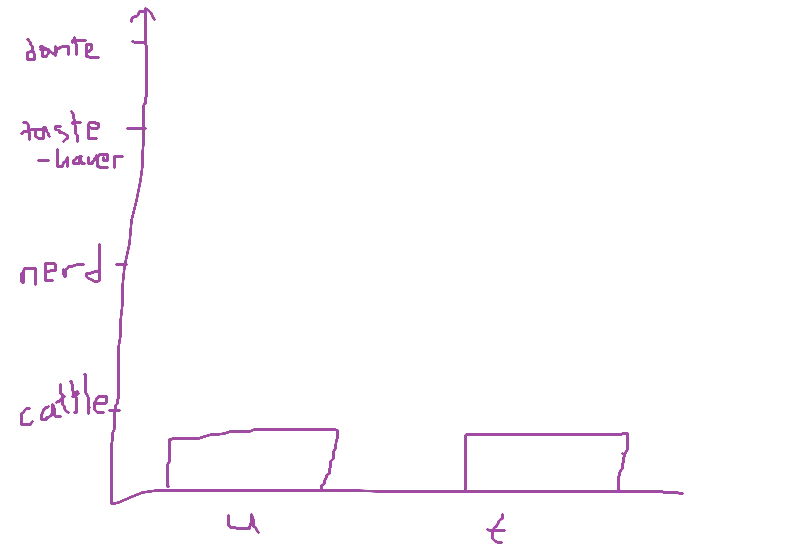
you then read some books, go to museums, argue with people online, and have some sexual experiences. your u goes up while t remains level.
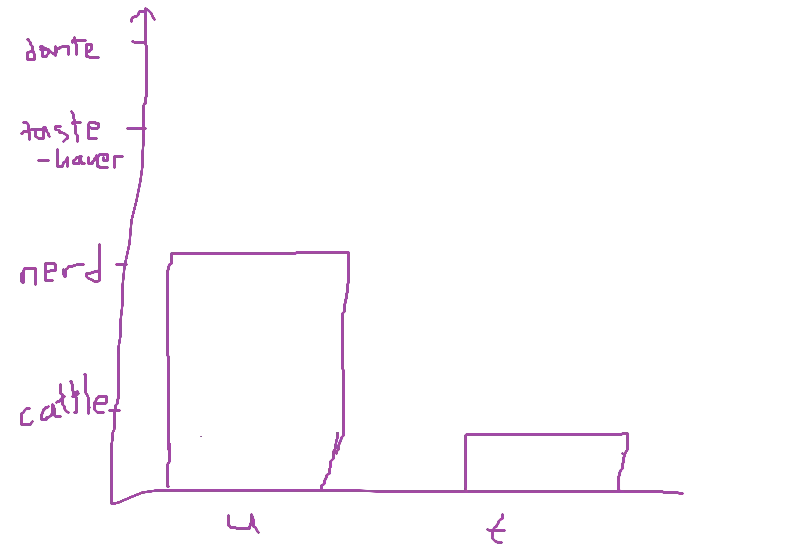
you then try to make some art. it is bad. you spend your potential taste and it converts (at a rate unique to you) into actualized taste. you are now, in the world's eye, something between a nerd and a cow.
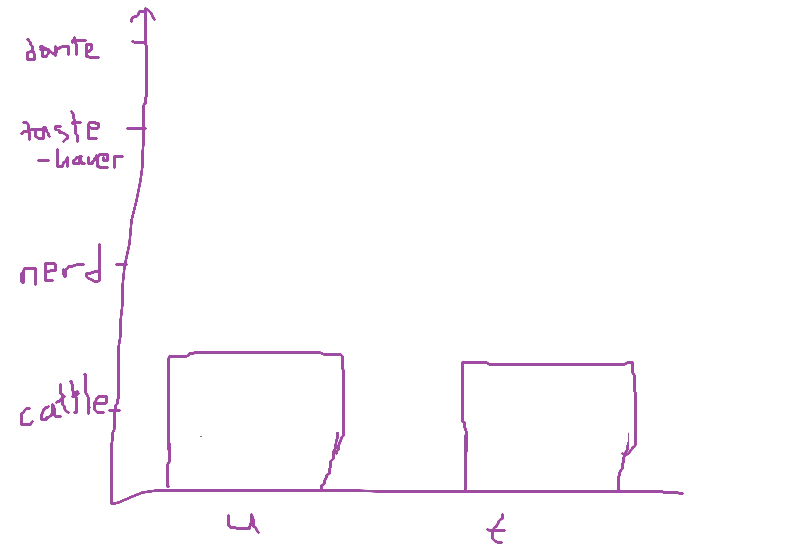
you keep consuming the same sort of stuff as before, but it provides no new potential taste. so you wisely seek out novel sources of good taste. you read the good stuff, fuss around systematically with craft, and find yourself an audience to entertain. you build your potential taste and then actualize it, becoming a bona fide nerd.
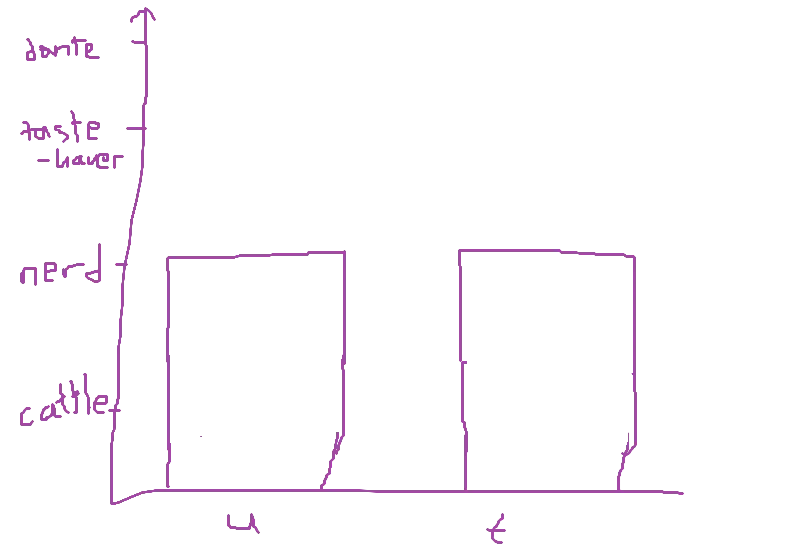
many people stay here forever. they have a process and know what they're about. they're ambitious to grow and please their audience, which is filled with cattle. consequently, there is no need to improve taste further.
however, some carry on... they seek out the best things, and breathe only rarefied air. they want to live like arthur rimbaud, and use art to induce higher states of pseudo-madness in themselves. they learn russian or something. their u spikes.
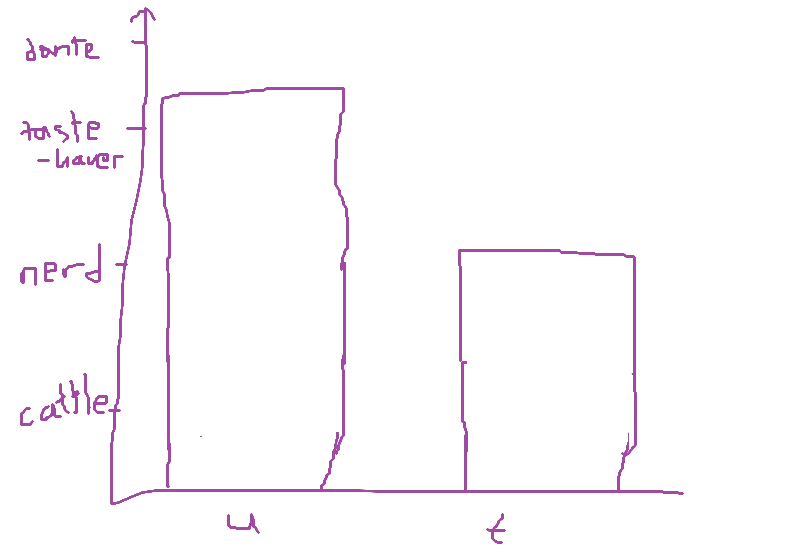
but none of this is actualized yet. how to actualize? you're surrounded by cattle and nerds who don't know what they don't know. what to do...? you cloister yourself among other nerd-elites, and you make each other try out new forms, new techne, unique to your generation. you found a journal or something, and self-publish a bunch of shit, until eventually something breaks through. you are now a true taste-haver.
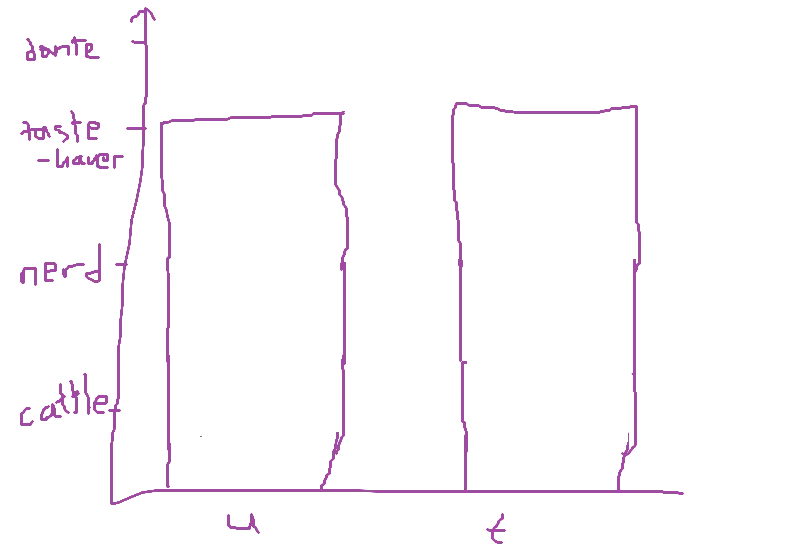
now what? how to ascend to dante-tier? there are no dantes around, so there is no one to emulate.
you and your peers are now forced to create a generational movement of artists, an avant garde, a scene! like florence 1500, london 1590, jena 1700, or paris 1920... an impudent generation of artists who've realized everyone who came before them was retarded or backwards. you compete with each other. maybe you're verlaine and you shoot rimbaud in the wrist. one of you becomes a dante. apotheosis.
the second set of explananda
how do such moments of intense artistic productivity come about? one might think that excess civilizational wealth produces excess artists, which eventually produces artistic revolutions. but this would imply that artistic achievement is explained endogenously by population size, and this is clearly not true. to create a great generation, it is not enough to generically produce a sufficient number of potential artists in your population ambiently. they need to be stuck in together, somehow. how does that happen?
here i'll point at some suggestive facts. all the aesthetic revolutions i listed above occurred in the presence of a sexual revolution. the 1700 jena set: goethe, novalis, schiller, fichte, the schlegels... all these guys were sleeping with each other's wives and mistresses, and their women in turn felt a great expansion in their own freedom. the same template holds true for florence, london, and paris (-- and of the beats, the beatles, the blues, punk rock, whatever...) in fact, i claim that all aesthetic revolutions are simultaneously political and sexual revolutions. look into it.
this explains why aesthetic revolutions belong to the young. no one wants an old fuck squeaking about, ruining everyone's fun.
to produce a new dante, we need a new aesthetic, produced by a new generation of artists, held together by a new sexuality. without any new sexual concepts, you'll end up with a culture that instead of producing dantes, will only produce youtube videos titled "the greatest french novels you have to read before you die", or debates on xitter about who is doing the "great books" correctly.
do not fear sex. do not fear "looking like a cult" because your scene has people having a lot of new, weird, and bad sex. all of that is, in fact, necessary, for new modes and orders to arise.
american elites now have such bad taste because their sexual modes contain no artistic ideals. caroline schlegel heard fichte talking about the primary of the Ich, the self, the will, and expressed her will by running through every artist-philosopher she could get her hands on. if your generation's aesthetics cannot produce people like this (i.e. those who are philosophically sexual, sexually philosophical), then get used to having no new dantes, bud.